


How to chose your skiboots?
What are the basic criteria for alpine ski boots?
The ski boot is the interface between the skier's foot and the ski, so its role is fundamental. The ski boot acts as well in the dynamic phases (in skiing) as in the static phases (at rest).
She must respect:
1. The natural general balance: the supports. To be comfortable, a skier must be balanced on his skis, the shoe must allow this balance.
2. The envelope of the foot: for better dynamics when cornering
3. Heel hold: which ensures contact with the ground and promotes pivoting
4. Holding of the forefoot: which allows the ski to be driven
5. The anatomy of the foot: for very good comfort.
Comfort or precision?
Without necessarily having to sacrifice one of the 2 points, it will be necessary to determine your main objective.
Apart from the materials that make up the liner, and the ability of the liner to match the shape of the leg, there are 2 criteria in the choice of a ski boot that will determine its level of precision and comfort:
=>Shoe width
Also called "fit": On our site, we distinguish 3 categories of width:
- Narrow
- Medium
- Large
It is therefore important to know your foot width at the widest weight level (usually the metatarsus).
To know your foot width:
1- Put your foot flat on the ground, stand upright so that your weight is distributed evenly over the entire surface of your foot
2- Use a measuring tape to take the measurement, place it at the widest point of your foot, generally located below the little toe and the bone of the big toe, then go around your foot with the meter (see illustration)
3- Take note of the measurement and refer to the size table to find the ideal width for your next shoes.
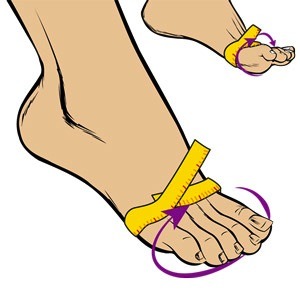
Measuring guide: Women sizes
| Size | Narrow | Medium | Large |
|---|---|---|---|
| 35 | 19.5 - 20.9 cm | 21 - 22.4 cm | 22.5 - 23.5 cm |
| 36 | 20 -21.4 cm | 21.5 - 22.9 cm | 23 - 24 cm |
| 37 | 20.5 - 21.9 cm | 22 - 23.4 cm | 23.5 - 24.5 cm |
| 38 | 21 - 22.4 cm | 22.5 - 23.9 cm | 24 - 25 cm |
| 39 | 21.5 - 22.9 cm | 23 - 24.4 cm | 24.5 - 25.5 cm |
| 40 | 22 - 23.4 cm | 23.5 - 24.9 cm | 25 - 26 cm |
| 41 | 22.5 - 23.9 cm | 24 - 25.4 cm | 25.5 - 26.5 cm |
| 42 | 23 - 24.4 cm | 24.5 - 25.9 cm | 26 - 27 cm |
Measuring guide: Men sizes
| Size | Narrow | Medium | Large |
|---|---|---|---|
| 40 | 22 - 23.4 cm | 23.5 - 24.9 cm | 25 - 26 cm |
| 41 | 22.5 - 23.9 cm | 24 - 25.4 cm | 25.5 - 26.5 cm |
| 42 | 23 - 24.4 cm | 24.5 - 25.9 cm | 26 - 27 cm |
| 43 | 23.5 - 26.4 cm | 25 - 26.4 cm | 26.5 - 27.5 cm |
| 44 | 24 - 25.4 cm | 25.5 - 26.9 cm | 27 - 28 cm |
| 45 | 24.5 - 25.9 cm | 26 - 27.4 cm | 27.5 - 28.5 cm |
| 46 | 25 - 26.4 cm | 26.5 - 27.9 cm | 28 - 29 cm |
=>Shoe Flex
This is the shoe's stiffness index. This index must be chosen according to its weight and level.
Range Men:
Data for a weight of 70 kg: Add 5 of Flex for each additional 10 kg
| Level/ Flex | Beginner | Advanced | Expert |
|---|---|---|---|
| Indice | 70 | 90 | 110+ |
| Flex | Soft | Medium | Hard |
Range Women:
Data for a weight of 50 kg: Add 5 of Flex for each additional 10 kg
| Level/ Flex | Beginner | Advanced | Expert |
|---|---|---|---|
| Indice | 60 | 80 | 100+ |
| Flex | Soft | Medium | Hard |
Choose the right shoe length
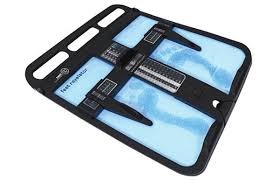
Measurement scale: Ski manufacturers use the mondopoint measurement, a universal measurement that expresses the length of the inner sole of the boot in centimeters. Use our online pedometer to find out your shoe size.
To know your exact size, it is necessary to take or resume the exact length of your foot using an online pedometer note.
Indeed, this system was established in order to use a universal process for all countries. It allows a logical correspondence between the length of the foot and the internal length of the shell.
The length is determined barefoot or with very thin socks. You should always measure both feet at the same time.
However, there may be a difference in size between the feet in many cases. This is why it is necessary to take the position in a standing position and the knees are slightly bent.
Make shoe at his foot! First of all, you should know that the bootie during the first few uses will heat up and naturally take the shape of your foot. A size adjustment of around 10% can thus be carried out. On the other hand, in store your foot is warm and dilated, while it will be cold on the slopes. it is therefore important not to rely only on the first impression if you feel your foot slightly adjusted in the shoe. We often recommend keeping the shoe closed for 10-15 minutes before getting a final opinion!
Test without bootie: Some professionals perform this test to find out if a shoe is the right size: remove the bootie from the ski boot and slide your foot inside and abut the end of your foot by bending towards before. If you manage to slide the width of 2 fingers (2 cm) between your heel and the shoe, it is that the size is good.
Test with slipper: Now put the slipper back in the shoe and put your foot on with the loops open. Your toe touches the end of the bootie? Do not panic, this is normal and is a sign of an adjusted bootie. Now close the loops (be careful if you tighten to the last notch of the loops, the model is too large). Once the shoe is closed, do a forward flexion by pressing the shins on the tongue. Your toe should no longer touch the bottom of the shoe.
Heel support: Depending on the size of your calf and the smoothness of your heel, you must check that your heel is well maintained and does not come off when you flex forward. If your heel takes off with a finger width or more, your shoe is ill-fitting.
Other options and settings
These points are fundamental whatever the level of the skier and his type of ski.
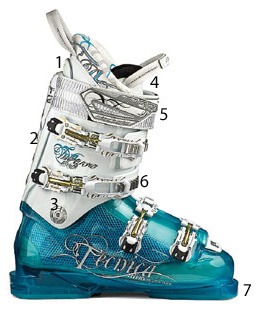
- Canting: present on the majority of the models, it is an adjustment of the angle of inclination left / right so that the shoe once laid flat, is well in the axis of the knee to avoid pain . This adjustment must be made using a spanner in a specialist store.
- 2, 3 or 4 loops? Traditionally, trail-oriented shoes have 4 loops, while free ski or hiking shoes have 3 or 4. For beginners to intermediate skiers, a 2-loop shoe has the advantage of being easier and quicker to tighten / loosen
- Sole with grip: Some shoes have a non-slip sole, which is very useful for treks on hard snow
- "Walking" position: Some models allow you to increase the inclination of the shoe thanks to a walking position, which is useful for hikes or slightly long approach steps.
What choice of socks should I make?
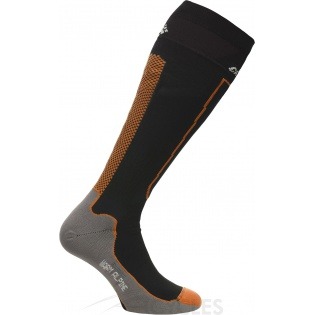
The sock is an important component for comfort in a shoe.
We recommend using socks specially designed for skiing. They must protrude above the upper of the boot so as not to interfere with the skier.
In addition, the socks should not have ribs or relief.
The skier must not wear nylons or tapered pants going down around the ankle and under the foot.
It’s good to know that for people who are prone to sweating, wool can absorb its own weight of water without giving the feeling of humidity.
In summary: How can I be sure of my choice of alpine ski boot?
When buying your shoe, it will be important to answer positively 5 essential questions for your future comfort:
1. Is the foot firmly held on all sides without the presence of particular hard points?
2. Are the toes free to move?
3. In forward flexion, is the heel well held at the bottom of the shoe?
4. Are the ankle and tibia properly wedged, without play or hard point?
5. Did you understand all the adjustments and the possibilities for customizing the shoe?